Hot shower this morning, stone-cold radiators tonight, and the heating should've come on an hour ago. Annoying as it is, hot water but no heating is one of the more hopeful faults a boiler can give you. As long as the boiler is what's heating that water, a hot tap tells you it can still get gas and light, so the problem nearly always sits between the boiler and the radiators: either nothing is asking for heat, or something isn't letting the heat through. If you've got a cylinder with an immersion heater, make sure the immersion is switched off before you trust that, because it can give you a hot tap while the boiler sits there dead.
What's behind it depends a lot on the kind of system you've got, so it helps to know before you start. No hot water cylinder anywhere in the house means a combi. A hot water tank tucked in the airing cupboard means a system or regular boiler, and the list of suspects is a little different. If you're not sure, the piece on telling the three boiler types apart will sort it in a minute.
Why a hot tap is good news
Your boiler does much the same thing whether it's warming a shower or a radiator. It lights the burner and heats water. So when the tap runs hot off the boiler, you know the burner, the gas valve and the ignition are doing their jobs, and that rules out a good chunk of what can go wrong inside it.
What's left is the chain that tells the boiler the house wants warming, which is the thermostat, the timer and the wiring between them, plus whatever sends the heat out to the radiators once it's made: a valve, and on some older systems a pump. A few of those links you can rule out yourself over a cup of tea, with nothing more than your eyes and maybe a couple of fresh batteries.
Start at the thermostat, not the boiler
Turn the room thermostat up a few degrees past whatever the room is now. An old dial thermostat will often click as it switches over, and a digital or smart one usually shows some sign on the screen that it's calling for heat. If nothing changes, the thermostat may not be asking at all, and that's sometimes all it is. It got turned right down in the summer, or knocked when the furniture moved, and nobody's touched it since.
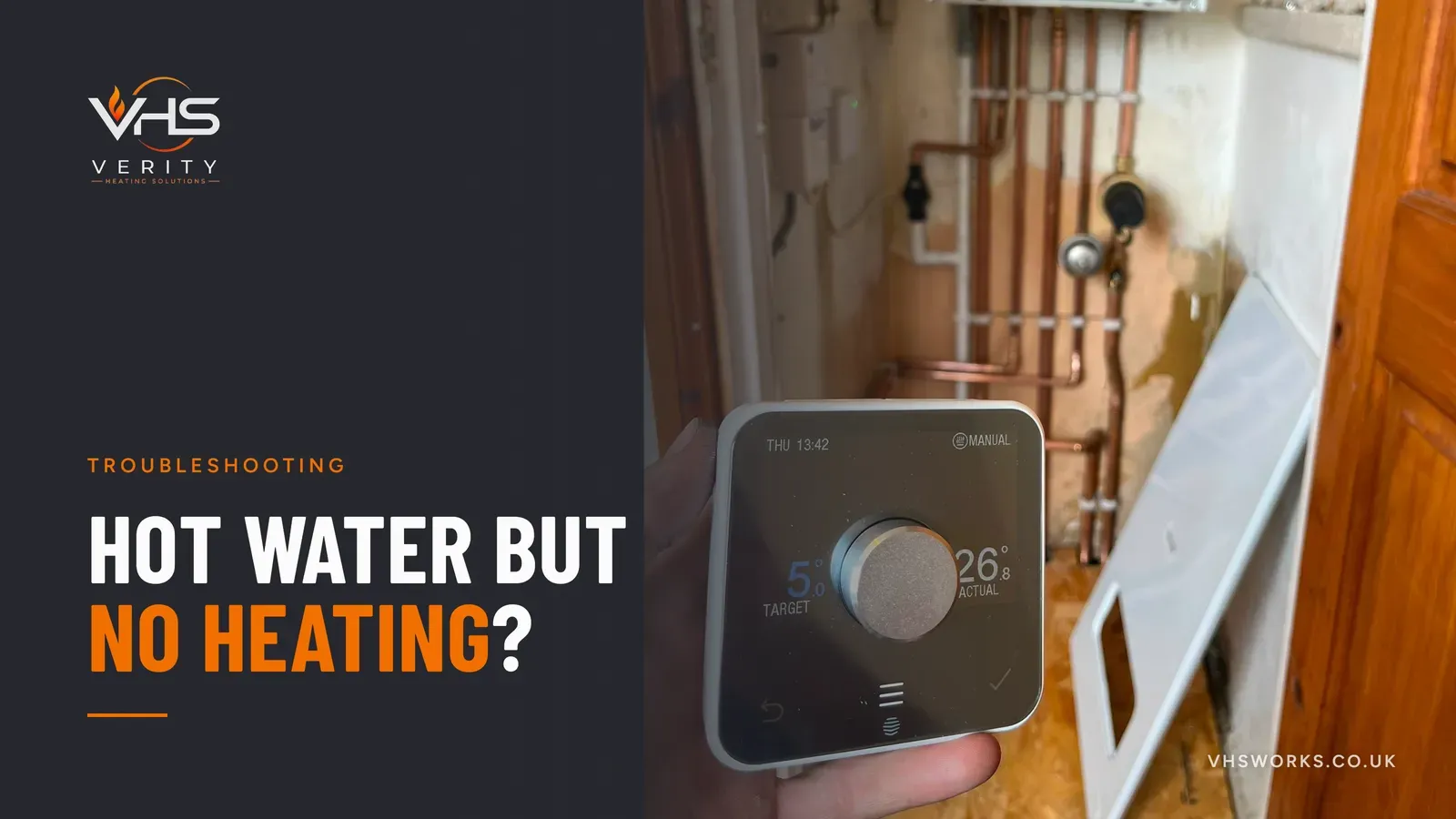
Look at the thermostat in the photo at the top. Its target is 5 degrees and it's reading nearly 27, so the boiler it runs won't put the heating on for anything. Smart thermostats add a few more ways to end up there: a holiday or away mode left switched on, a schedule changed in the app, or a frost setting that only heats the house when it's close to freezing indoors.
Wireless thermostats have their own catch. They talk to a receiver box near the boiler, and when the batteries run low they can stop getting the message through before the screen goes blank. New batteries cost a couple of quid, so they're the cheapest thing on this whole page to try.
Then look at the timer or programmer. A power cut can knock it back to its factory times or leave it flashing at midnight, and an old dial timer with little pins round the edge needs moving by hand when the clocks go back in October. Many programmers have a separate heating channel and hot water channel, and it's very easy to switch the heating side off for summer, leave the hot water running, and forget all about it by November.
Last, the boiler itself. Most have a heating dial or button, usually marked with a radiator symbol, and plenty of models let you turn the heating side off for the warmer months while the hot water carries on. Some call it summer mode. Left that way, the boiler will cheerfully heat your shower and ignore the radiators all winter.
On a combi, the diverter valve is the usual suspect
A combi heats your taps or your radiators, never both at once. Open a hot tap and a part called the diverter valve sends the heat to the tap instead of the radiators, then flips back when you turn the tap off. If it sticks on the hot water side, you get great showers and cold radiators, which is probably what brought you here. It's the mirror image of what happens when the hot water goes but the heating doesn't, where the same valve sticks the other way.
Sometimes the valve itself has seized, and sometimes it's the small motor that drives it. Either way it lives inside the casing, so it's a job for a Gas Safe engineer and not something to have a go at. As a rough guide, a diverter valve typically costs £180 to £320 to replace with parts and labour. That's what the work normally goes for, not Joe's quote, and the rest of the typical figures are on the boiler repairs page.
Got a cylinder? Look at the motorised valve
With a system or regular boiler, the heat has two places it can go, the radiators and the coil inside your hot water cylinder, and motorised valves decide which gets it. You'll usually find them in the airing cupboard close to the cylinder: a brass valve on the pipework with a small white or grey box on top that holds the motor. Some houses have a single valve with three pipes coming off it, which shares the heat between both jobs. Others have two separate valves, one for the heating and one for the hot water.
When the motor on the heating valve burns out, the valve stays shut, so the cylinder keeps getting heated and the radiators never get a look in. These valves can fail in a sneakier way too. Inside the box on most of them is a little switch that tells the boiler the valve has opened and it's fine to fire. If that switch packs up, the boiler never hears that the heating wants it, so it just sits there quietly and you'd swear nothing was wrong with it.
Leave the box closed, because it's wired to mains electricity. It's rarely a big job to put right, though, since the motor head can often be swapped on its own without draining the system.
Older houses and gravity hot water
Round Barnsley and the Dearne Valley you'll find plenty of houses built before the war, terraces and 1930s semis especially, and some of them still have heating laid out decades ago, back boilers and gravity systems included. On a gravity system the water heating the cylinder isn't pumped at all. Hot water rises on its own, so it finds its way up to the cylinder whatever the pump is doing. The radiators are a different story, because they rely on that pump to push the water round.
So when the pump fails, the hot water carries on as if nothing has happened and the heating stops dead, which is exactly the pattern you're seeing. The pump is usually a small round-bodied unit on the pipework, often in the airing cupboard or next to the boiler. If it's silent when the heating should be on, or humming away without the radiators warming, it's the likely culprit. A new circulating pump typically runs £200 to £380 fitted, more if the valves either side have seized as well. That's the going rate rather than Joe's quote. On a system that old he'll also say whether a pump is enough or whether it's time for a rethink, and the article on whether to repair or replace an old boiler is a good read if you're weighing that up.
Only some radiators cold?
If some radiators come on and others stay cold, it's a different problem, and your boiler is very likely fine. Usually it's a radiator valve stuck shut, air trapped at the top, or sludge sitting in the bottom.
Stuck valves are really common when the heating first goes back on. The thermostatic head on the side of the radiator presses down on a little pin, and after months sitting at a low setting that pin can stick. Most heads unscrew or pop off by hand, and if the pin underneath is stuck down, a gentle tap or a wiggle with a pair of pliers often frees it. Then pop the head back on.
A radiator that's cold across the top and warm lower down has air in it, and a radiator key plus five minutes of bleeding usually sorts it. Check the pressure gauge on the boiler afterwards, because letting air out lets a bit of pressure go with it. The other way round, warm up top with a cold band along the base, is sludge, and the guide to radiators going cold along the bottom goes through what to do about it.
Where the do-it-yourself bit ends
Everything above happens outside the boiler. Once you've been through the thermostat, the timer, the batteries and the radiator valves and the house is still cold, the fault is inside the casing or in the wiring that links your controls, valves and pump. That's the point to stop. Anyone you pay to work on a gas boiler has to be on the Gas Safe Register by law, and opening the casing yourself isn't safe whatever the rules say. The wiring centre that ties the controls together runs on mains voltage too.
As for whether it can wait, Joe will give you an honest answer on the phone. With the hot water still working you can wash, cook and fill a hot water bottle, so for a lot of households this is a book-it-in job for the next weekday, and he'll say so rather than charge you the emergency rate. If it's freezing out and there's a baby, someone elderly or someone poorly in the house, that changes things, and it's exactly what his emergency boiler repair service is for.
Finding where the heat stops
Tracking this fault down means following the call for heat from the thermostat to the boiler and finding the spot where it goes quiet. In practice that's checking the thermostat is asking and the receiver is hearing it, that the valve opens and its switch tells the boiler, and that the pump turns. Somewhere along that line the message stops, and that's the part that gets fixed. If it turns out to be flat batteries or a timer set wrong, Joe will say so and leave it there.
Before he touches anything you'll have a fixed price, and that figure stays put. Once the fault's sorted, the boiler goes on the flue gas analyser to make sure it's burning properly, he shows you the radiators warming up, and you pay when it's done. Joe takes your call, finds the fault and does that final test himself, so nobody new turns up halfway through and you never have to explain it twice. One of his customers, Louise, summed him up on Google: "Excellent communication. Always provides detailed reasons for chosen repair. Good value."
Verity Heating Solutions is registered under number 633652, so by all means check us on the Gas Safe Register. Joe's based in Barnsley and works right across the patch, from Doncaster to Wakefield, Sheffield and Rotherham. If your radiators are still cold, ring Joe on 07791 793415 or send him a WhatsApp on it. A photo of your thermostat and of the pipework in the airing cupboard gives him a head start.