You've had a dull headache for a few days, the kids are tired and grumpy, and everyone puts it down to the time of year. Then someone mentions it's always worse in the evenings, once the heating has been running for a few hours. The signs of carbon monoxide are easy to miss because they look like so many other things: in people it's headaches, dizziness, sickness and tiredness that ease when you go outside, and around the house it's yellow or orange flames, soot or brown staining on an appliance, and more condensation on the windows than usual. If any of that rings a bell, it's worth taking seriously today, not next week.
Carbon monoxide has no colour and no smell, so you won't pick it up by sniffing the air or staring at the boiler. You can learn the clues, though, and know exactly what to do if you spot them, and an alarm will do the listening for you while everyone's asleep.
The symptoms people put down to a cold
According to the NHS, the usual ones are headaches, feeling dizzy, sick or weak, being tired and muddled, aches in the chest and muscles, and getting out of breath. HSE says they're easily confused with food poisoning, a virus, flu or plain tiredness, and you can see why. Nobody rings a gas engineer because they've got a headache.
So the symptoms on their own don't tell you much. What gives it away is when and where they come on, and whether the rest of the house feels the same way.
Clues that it's the house, not a bug
The biggest clue is where you feel rough. The NHS points out that the symptoms can come and go: they tend to build while you're in the room or house where the gas is, and ease off once you step outside. If your head clears on the walk to work and comes back an hour after you get home, that's a pattern worth noticing.
A few other things should make you suspicious. Everyone in the house feeling off at once, without anyone having been near a sick friend, is one. Symptoms that started around the time the heating first came on for the winter is another, since that's when a boiler or gas fire that's sat idle all summer suddenly starts running for hours a day. And if it's worse in one particular room, have a look at what burns gas in that room.
None of this proves anything, and plenty of headaches really are just headaches. But carbon monoxide is one of those things where being wrong in the cautious direction costs you an afternoon, and being wrong the other way can cost a great deal more.
What your boiler and other appliances can show you
HSE lists four things to look out for on gas appliances, and they're all things you can check without touching anything.
- A flame that's gone yellow or orange where it should be blue. A gas hob, or an older boiler where you can see the flame, should burn crisp blue, and a floppy yellow one means the gas isn't burning properly. A fuel-effect fire is the exception, because it's meant to look like that.
- Soot, or yellow and brown staining, on and around the boiler casing, above a gas fire, or on the wall or ceiling near the flue. Fresh marks that weren't there last year matter most.
- A pilot light that keeps blowing out. It's mostly an older-appliance thing, but if yours does it, don't keep relighting it and hoping.
- More condensation on the inside of the windows than you'd normally get. Lots of things cause it, from drying washing to cooking, so on its own it's a weak clue, but alongside one of the others it counts for more.
Most modern boilers are room-sealed, which means they take their air from outside and send the fumes straight back out through the flue, so you won't see a flame at all. On those, the casing, the flue and the area around them are what to look at. A dark stain creeping out from under the casing, a flue joint that looks disturbed, or a terminal outside that's been covered by ivy, a bag or a new extension all deserve a proper look from someone qualified.
If you think it's happening right now
Don't stand in the kitchen reading this. HSE and the NHS give much the same advice between them, and it comes down to five steps.
- Stop using the appliance you suspect. Switch the boiler, fire or cooker off.
- Shut off the gas supply using the lever on the pipe next to your meter.
- Open doors and windows, then get everyone out into fresh air.
- Phone 0800 111 999. That's the gas emergency number for England, Scotland and Wales, it costs nothing, and someone picks up day or night.
- Get medical advice. The NHS says to call 111 if you think you have symptoms, and 999 if someone is struggling to breathe, has suddenly become confused, has passed out, or is feeling weak or getting pains in the chest or muscles. Don't drive yourself to A&E.
Don't go back inside until you've been told it's safe. The emergency service's job is to make the gas safe, and the repair is a separate job for a Gas Safe registered engineer afterwards.
When a boiler fault can safely wait until Monday, Joe says so, and you're spared the out-of-hours price. This is the one situation where he'll tell you the opposite. A suspected carbon monoxide leak is never a wait-and-see job, and the gas emergency number comes before anyone else's, his included.
Why a boiler starts making carbon monoxide
Gas that burns cleanly produces mostly carbon dioxide and water vapour. Carbon monoxide comes from gas that isn't burning cleanly, usually because the balance of gas and air inside the boiler has gone wrong, or because the fumes aren't getting out the way they should.
The usual suspects are ordinary wear and tear rather than anything dramatic: a flue that's been knocked, split or blocked, a seal on the combustion chamber that's perished, a burner or heat exchanger choked with debris, or a boiler that's simply never been serviced and has drifted out of setting over the years. Older open-flued appliances, like back boilers and some gas fires that draw air from the room, carry more risk because the room itself is part of how they breathe. Block the vent in that room to stop a draught and you can starve the fire of the air it needs.
None of these faults announces itself. A boiler can heat the house perfectly well while burning badly, which is exactly why it pays to have someone measure it.
Carbon monoxide alarms: where they go and what the rules say
An alarm is the only thing in the house that can actually detect carbon monoxide, so it's worth having one even if you service everything religiously. The NHS advice is one alarm in each room that has an appliance burning gas, oil, coal or wood.
As for where it goes, the government's guidance for landlords says head height, on a wall or shelf, about one to three metres from the appliance. Building Regulations guidance for a newly fitted appliance puts it higher, on the ceiling or high up the wall, still one to three metres away. Either way, the leaflet in the box has the final say, so give it a read before you get the drill out. Test it when you change the clocks, and check the back for the replace-by date, because the sensors don't last forever.
If you're a landlord, the law has a say as well. In England, since 1 October 2022, every room in a rented home that people live in and that contains a fixed appliance burning fuel, such as a boiler or a gas fire, has needed its own carbon monoxide alarm. Gas cookers don't count. Landlords also have to repair or replace an alarm once they're told it's faulty. And under current Building Regulations guidance in England, a new or replacement boiler should come with a carbon monoxide alarm, so whoever fits a new boiler should put one up in the same room.
Look for one marked BS EN 50291 on the box. Cheap unbranded alarms bought online are a gamble you don't need to take for the sake of a few pounds.
What a proper service checks
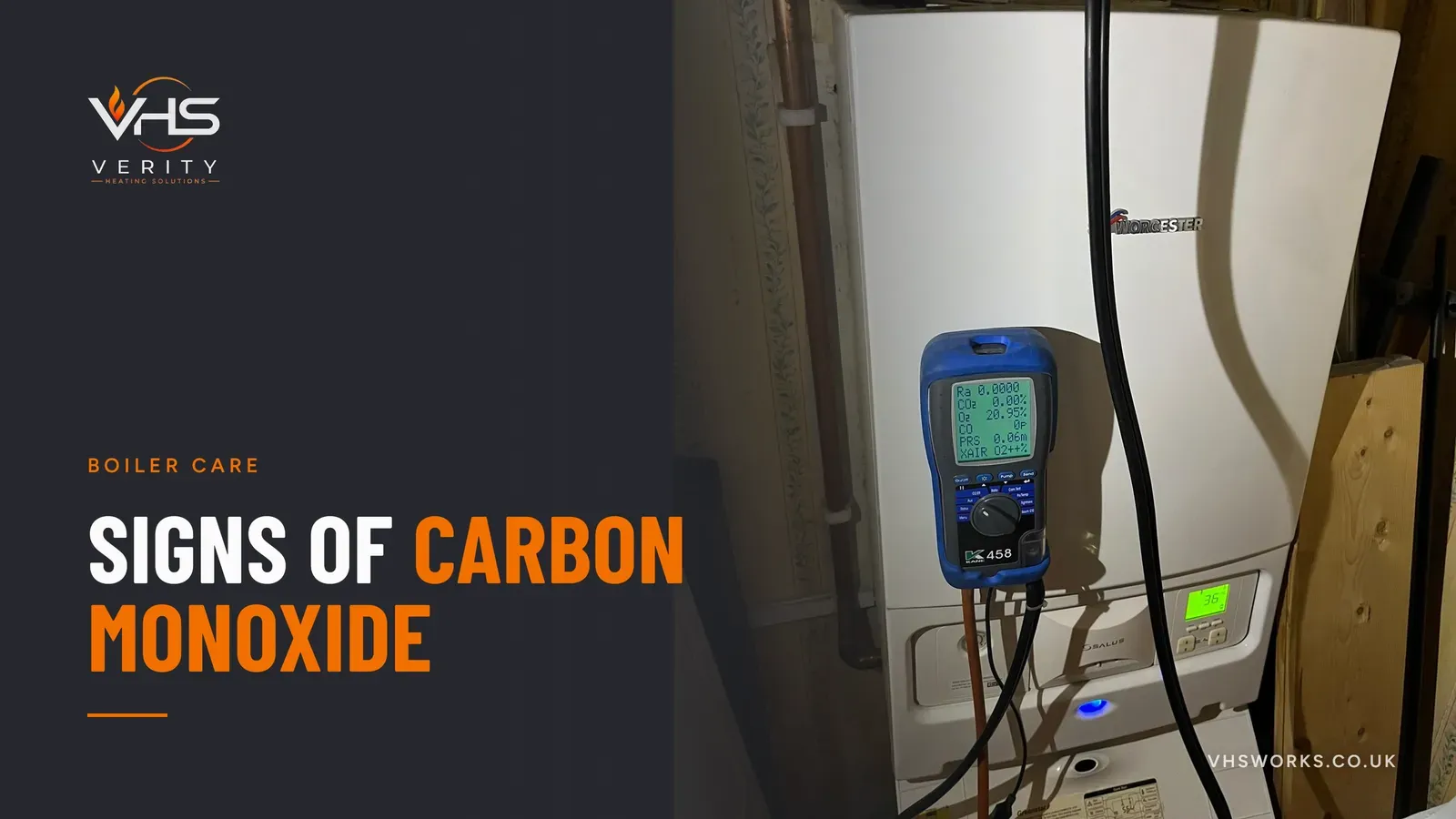
An alarm will tell you once there's carbon monoxide in the room, but a service is how you stop the boiler making it in the first place. Every boiler Joe works on gets tested with a flue gas analyser, which measures what the flue is actually giving off, carbon monoxide included, and he won't call a job finished until he's shown you it working.
Alongside the readings, a proper service means the casing comes off, the seals and flue joints are checked, and the burner and heat exchanger get inspected and cleaned if they're dirty. There's a full rundown of what to expect, and how to tell if it was actually done, in our boiler service checklist. If yours is overdue, Joe offers boiler servicing in Barnsley and the villages round about, and he'll tell you straight how often yours really needs doing.
The business's Gas Safe number is 633652, and if you'd like to see the entry for yourself, check us on the Gas Safe Register. Look up anyone else the same way before they touch your boiler. HSE is clear that anyone paid to work on gas appliances has to be on that register, and if they won't give you a number, don't let them in.
If you're a landlord, or you rent
On top of the alarm duties, landlords need a yearly gas safety check covering each gas appliance and flue they provide, and that check includes looking for exactly the faults that produce carbon monoxide. Joe does landlord gas safety certificates, and our guide to the landlord gas safety rules covers what has to be done and when.
If you rent and you've spotted one of the signs here, tell your landlord in writing straight away, and if you think there's carbon monoxide in the house right now, follow the steps above first. Ringing the gas emergency number doesn't need anyone's permission.
Worried about yours?
If you've noticed staining on the casing, a flame that's gone yellow, or a boiler nobody has looked at in years, ring Joe on 07791 793415, or send a WhatsApp to that number. He'll ask what you're seeing and say honestly if it needs looking at today, and whenever he comes out, the person you spoke to is the person at your door. As well as Barnsley he works across Doncaster, Wakefield, Rotherham and Sheffield.