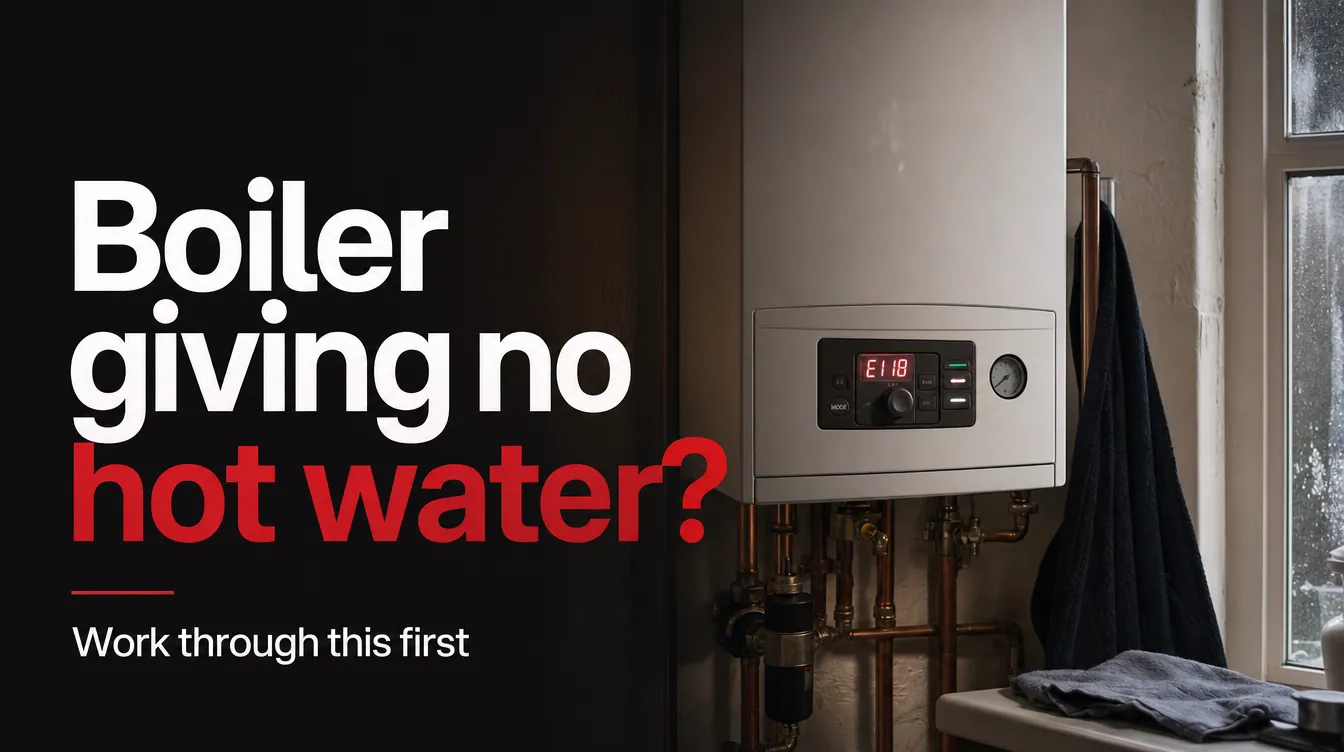
A boiler with no hot water is nearly always one of a short list of faults, and which one depends on a single question: do the radiators still get hot? If they do, a combi has usually lost its diverter valve or blocked its plate heat exchanger. If the heating has gone as well, start with pressure, power and gas.
This guide goes through it in the order Joe would on the phone: the checks that cost nothing first, then what each pattern of symptoms points to, then what it tends to cost to put right.
Which kind of hot water system do you have?
It matters, because the two kinds fail in different ways.
A combi heats water at the moment you open a tap. There is no tank and no cylinder anywhere in the house. When a combi stops giving hot water, the fault is inside the boiler or in what feeds it.
A system or regular boiler heats a cylinder, usually in an airing cupboard, and the taps draw from that store. When one of these runs cold, the boiler itself is often fine and the fault is in the controls or valves between the two. Not certain which one is yours? The piece on choosing between the three boiler types shows how to tell in a minute.
What can you check before you ring anyone?
Work down this list. A fair number of no hot water calls end at one of these, and none of them needs a tool.
Is the boiler alive? Look for a lit display or a power light. A tripped fuse spur or a switch knocked off by the ironing board is behind a surprising number of visits.
What does the pressure gauge say? Below roughly half a bar a boiler will normally refuse to fire. Topping it up is a two minute job, and the steps are in our pressure loss guide.
Is there gas? Light a ring on the hob. If you are on a prepayment meter, check the credit before anything else.
Has the programmer changed? A power cut or the clocks going back can leave the hot water timed for the wrong hours, or switched off entirely. This is the first thing to look at with a cylinder.
Where is the hot water dial set? On a combi it is the one marked with a tap. It gets turned down by accident more often than you would think.
Has it been freezing outside? A boiler that gurgles, shows a fault code and will not fire on a frosty morning has very likely got a frozen condensate pipe. That is the plastic waste pipe running outside to a drain. Pour warm water along it, never boiling, then reset the boiler.
Reset it once. If it fires and stays on, fine. If the same fault comes back, leave it alone and write the code down.
That is where the safe list ends. The casing stays on. Everything behind it is gas work, and by law that is for a Gas Safe registered engineer only.
Boiler has no hot water but the heating works: what is wrong?
On a combi this is the most common pattern of all, and it narrows things down to four parts.
The diverter valve
A combi can only do one job at a time. The diverter valve is what swings the boiler's heat away from the radiators and over to your tap the moment you open it. When it sticks, the heat carries on going to the radiators and the tap gets little or none.
There is a test you can do yourself. Turn the heating off at the thermostat, wait for the radiators to cool, then run a hot tap for a few minutes. If the radiators start to warm up, the valve is not closing properly and you have found it.
The plate heat exchanger
This is the part that actually heats your tap water: a block of thin metal plates with boiler water on one side and mains water on the other.
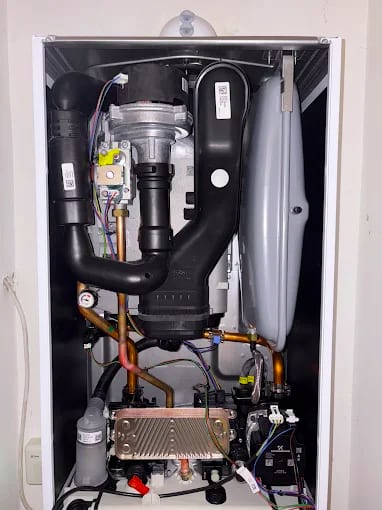
In the photo it is the ribbed metal block at the bottom. Over the years it clogs, with limescale on the tap side or sludge from the radiators on the other. The hot water does not vanish overnight. It gets weaker month by month, then turns lukewarm, then starts swinging between warm and cold.
Which of the two is clogging it depends on where you live. In harder water areas such as Rotherham, scale is the usual culprit. Where the water is soft, it is more often sludge, and that is a sign the whole system wants cleaning. There is more on that under radiators and powerflushing.
The flow sensor
A combi has to notice that a tap has been opened before it will fire. A small sensor on the cold inlet does that job. If it jams or fails, you open the tap, the boiler does nothing at all, and the water stays stone cold while the radiators behave as if nothing is wrong.
The temperature sensor
A small sensor tells the boiler how hot the tap water is. When it starts misreading, the boiler shuts the burner down early or lets it run too long, so you get water that is scalding one minute and tepid the next.
Why does the hot water run hot, then cold, then hot again?
Three things cause this, and only one of them is a fault.
The first is a part-blocked plate heat exchanger, as above. The boiler overheats its own water, cuts the burner to protect itself, cools, fires again, and you feel every cycle in the shower.
The second is flow. A combi needs a certain amount of water moving through it to stay lit. Open a tap only a little, or use a shower with a water-saving head, and the flow can drop below that point so the burner cuts in and out. Opening the tap further cures it.
The third is winter. A combi adds a fixed amount of heat to whatever comes in from the main, and in January the mains water arrives much colder than it does in July. The same boiler on the same setting gives cooler water at the same flow. If it happens every winter and goes away every spring, the boiler is not broken. Run the tap a little slower and it will come hotter.
What if you have a hot water cylinder?
Start with the controls, because that is where most of these end.
Check the programmer has hot water switched on and timed for when you need it. Then find the thermostat strapped to the side of the cylinder. It should be set at about 60 degrees, which is the storage temperature the Health and Safety Executive gives for keeping legionella bacteria in check. If someone has turned it right down, the boiler thinks the cylinder is already hot.
If the controls are right and the cylinder is still cold while the radiators are hot, the usual suspect is a motorised valve. It is a small box on the pipework near the cylinder that opens to let boiler water through the coil. The motor inside wears out, the valve stays shut, and the cylinder never gets its turn. It is one of the cheaper repairs on any heating system.
In the meantime, most cylinders have an electric immersion heater with its own switch on the wall nearby. It will give you a tank of hot water in an hour or two.
One caution. If your cylinder is the pressurised kind, with no tank in the loft, do not touch the valves on it, and ring if you see water running from the small open funnel on its pipework. Those are safety devices and need someone qualified for that type of cylinder.
What if there is no heating and no hot water at all?
Then the boiler is not firing for anything, and that is a different and usually simpler list: pressure too low, no power, no gas, a frozen condensate pipe, or a lockout the boiler has put itself into for a reason. The checks at the top of this page cover every one.
If none of them brings it back, the fault is inside. A failed pump, a fan, an ignition fault or a circuit board will all stop a boiler dead. The code on the display is the most useful thing you can pass on, so photograph it before you reset anything.
One rule sits above all of this. If you smell gas, or a carbon monoxide alarm sounds, leave the boiler alone, get the windows open and call 0800 111 999, the national gas emergency number.
What does it cost to fix, and can it wait?
Most boiler repairs come in between £100 and £500 with parts and labour together. A diverter valve, the classic cause of hot water going while the heating stays, is typically £180 to £320. Those are going rates for this kind of work and not a quote. The full table is on the boiler repairs page, and your own fixed figure comes once Joe has found the actual fault.
Whether it can wait is a fair question, and one Joe will answer straight. No hot water with the heating still on is miserable but rarely urgent for a healthy household, and waiting for a normal weekday visit keeps the bill down. A house with a baby, somebody elderly or somebody unwell is a different matter, and so is no heat at all in a cold snap. That is what emergency boiler repair is for.
When Joe does come out, the casing comes off and the fault is found before a part is ordered. On a hot water fault that means watching what the boiler does when a tap opens: whether it notices, whether it fires, where the heat goes, and how hot the water leaves. Those four answers separate the four parts above, and you are told which one it is and what it costs before he starts.
Joe's Gas Safe number is 633652, and his round takes in Barnsley, Sheffield, Rotherham, Wakefield and Doncaster. Ring 07791 793415 and say three things: whether the radiators still heat, what the display shows, and what the water does in the first minute of running. That is usually enough for him to name the likely cause.