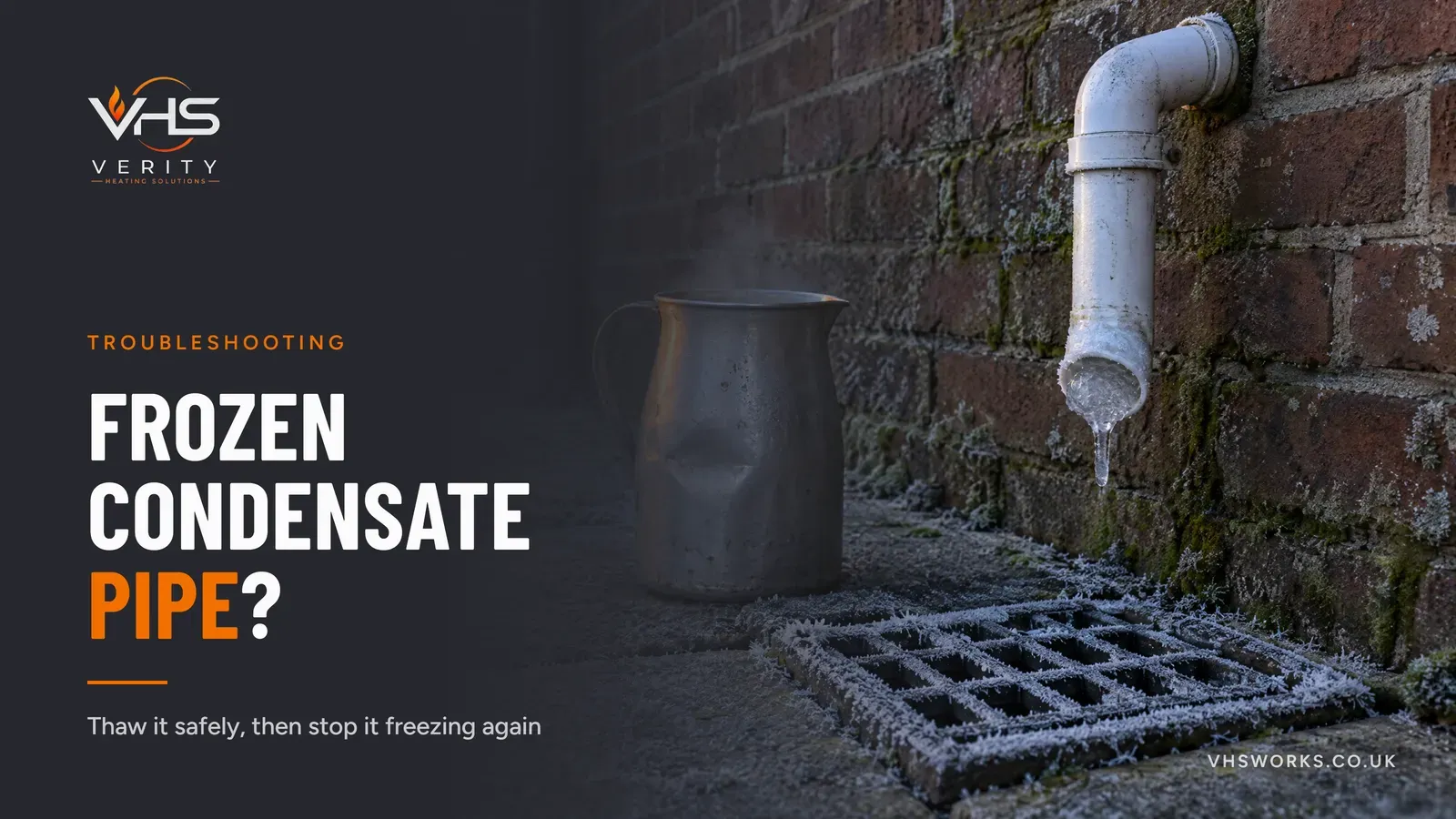
Freezing morning, the boiler gurgles, tries to light and gives up. When that happens to a condensing boiler, there is a good chance it is a frozen condensate pipe, and you can usually thaw it yourself without calling anyone out. Find the white plastic pipe that runs from the boiler to a drain outside, pour warm (never boiling) water along it until the ice clears, then reset the boiler. If that is the cause, nothing inside the boiler is broken. It has shut itself down because its waste water has nowhere to go.
Joe Haywood of Verity Heating Solutions is a Gas Safe registered engineer based in Jump, Barnsley. This is the fix worth knowing before you ring.
Why does a condensate pipe freeze?
A condensing boiler squeezes extra heat out of its own exhaust gases. As those gases cool, the water vapour in them turns back into liquid, and that slightly acidic water has to be carried away. Worcester Bosch puts the amount at up to 2 litres an hour while the boiler is running. Seeing it drip is a sign the boiler is working the way it should.
The water leaves through a plastic pipe, much like a sink waste. Where that pipe stays indoors and runs into a sink waste or a soil stack, freezing is rare. Where it goes out through the wall and down the brickwork to a gully, it is exposed. Condensate trickles rather than flows, so on a night well below zero a slow drip can freeze where it sits, layer on layer, until the pipe is plugged solid. Wind across an open gable makes it worse.
How do you know it is a frozen condensate pipe?
Look for these together:
- It is properly cold. Usually after a night or two below freezing, often first thing in the morning when the heating comes on.
- A gurgling noise from the boiler. That is condensate backing up with nowhere to drain.
- The boiler has locked out with a code. Worcester Bosch boilers may show EA. Baxi says most of its boilers show E133 or E28, with E133 flashing up as E1 then 33. Other makes use their own codes, so check your boiler's manual.
If the boiler tried to light, gurgled and gave up, and the pipe outside has ice in it or at its end, you have your answer. If it is a mild day and the pipe is clear, it is something else, and it is worth a look at why a boiler stops giving hot water before you ring anyone.
How do I thaw a frozen condensate pipe?
- Find the pipe. Outside, near where the boiler sits on the inside wall, look for a white or grey plastic pipe about the width of a sink waste. It normally runs down the wall and ends over a drain or into the ground.
- Find the ice. Baxi's advice is that the blockage is most likely where the pipe is most exposed: at its open end, or at a bend or dip where water collects. Tap along it. A section that sounds solid, or an end with an icicle hanging off it, is where to start.
- Warm it, gently. Pour warm water slowly along the frozen section from a kettle that has been left to cool, a watering can or a jug. Water around the temperature of a hot drink is plenty. Never use boiling water, which can crack or split the plastic. A hot water bottle or a microwaveable heat pad held against the pipe works too.
- Keep going until it runs. You will often hear the ice let go, and water will start to come out of the end.
- Reset the boiler. Use the reset button or the steps in the user manual. It should light and run normally.
Two warnings, both from the manufacturers. Take real care carrying hot water across icy ground. And any water you spill will freeze too, so the path you just walked on may be worse on the way back.
Only thaw the pipe if you can reach it from the ground. If it runs down from a first-floor boiler and the frozen part is above head height, do not climb a ladder on ice to get to it. That is a call to an engineer.
What if the boiler still will not restart?
Try one reset. If it locks out again straight away, there may still be ice further along the pipe, or the pipe may never have been the problem.
If you have thawed the whole run you can reach and it still will not fire, stop. Leave the casing on. Behind the front panel of a gas boiler, only someone on the Gas Safe Register should be working. The same goes for a boiler whose gauge is also dropping while it locks out. That is a separate fault, and what a falling pressure gauge means explains it.
This is where Joe's phone triage earns its keep. Ring and describe what you are seeing. If it is a pipe you can thaw yourself, Joe will say so. If it needs a visit, he will give you a straight answer on whether it has to be today or can safely wait, and if it can wait you do not pay the emergency rate.
Stopping a frozen condensate pipe next winter
Thawing fixes today. If your pipe froze once, it will freeze again the next time the weather turns, so it is worth sorting properly. Some of this you can do, and some of it is a job for an engineer.
Things you can do yourself
- Lag the outside run. Use pipe insulation that is made for outdoor use and waterproof. Worcester Bosch specifies Class O insulation with a weatherproof outer coating.
- Turn the boiler's heating dial up in a long freeze. Worcester Bosch suggests turning the central heating temperature on the boiler to maximum during prolonged cold. Hotter water means the boiler condenses less. The radiators will run hotter and the boiler will be slightly less efficient while you do it, so turn it back afterwards.
- Cover the end. A drain cover over the open end of the pipe reduces wind chill on it.
Things an engineer can do
Worcester Bosch's own guidance says the condensate pipe should run inside the house wherever possible, with an outside run allowed only as a last resort. Where it does have to go outside, the same guidance asks for a pipe that is fully insulated, at least 32mm across, no longer than 3 metres, with as few bends as possible, and falling continuously away from the boiler at an angle of at least 3 degrees.
A lot of older installs fall short of that. If yours does, these are the fixes, starting with the one Worcester Bosch prefers:
- Re-route it indoors. Into the kitchen sink waste, a washing machine standpipe or the soil stack, so the pipe never sees the cold. This is the preferred answer wherever the layout allows it.
- Upsize and shorten the outside run. Swapping a narrow pipe for 32mm and cutting the outside length down gives the water less chance to freeze.
- Take the bends and dips out. A run that sags or kinks holds water, and standing water is what freezes first.
- Trace heating. A low-power heating cable along the outside pipe, for runs that cannot be changed.
If your pipe has frozen before, say so when you book a service, and ask for the outside run to be checked as well. Details are on the boiler servicing in Barnsley page.
Is a frozen condensate pipe dangerous?
Not in itself. The boiler shuts down precisely so that nothing unsafe happens, and a lockout is the boiler protecting itself rather than a sign of a gas problem. The real risks are around it: a slip on ice with a jug of hot water in your hand, or a household left in the cold for too long while you wait for the weather to turn. If there is anyone at home who cannot be without heat for long, do not wait it out.
Anything that smells of gas is a different matter entirely. Ring the gas emergency number, 0800 111 999, straight away. Open the doors and windows, put out any naked flames and do not smoke, and do not touch light or power switches. Turn off your gas appliances, and shut the gas off at the meter if the emergency service tells you to. Keep people away and get outside if you can. If the smell is in a cellar, do not go in.
When to ring Joe
Ring if the pipe is out of reach, if you have thawed what you can and the boiler still locks out, or if the pipe freezes winter after winter and you want it sorted for good. For a boiler that has stopped altogether and cannot wait, see emergency boiler repair, and for anything else that has gone wrong with it, boiler repairs in Barnsley.
One engineer does the whole job, from the phone call to the test at the end. Joe answers 24 hours a day, 7 days a week, and works out from Jump to Wakefield, Doncaster, Sheffield and Rotherham as well as Barnsley itself (see the Sheffield area page and the rest of the towns he covers). Gas Safe registration 633652, and anyone can look it up: check us on the Gas Safe Register.
Call 07791 793415 and ask for a straight quote or a straight answer. You can also WhatsApp the same number with a picture of the pipe and the boiler's display.