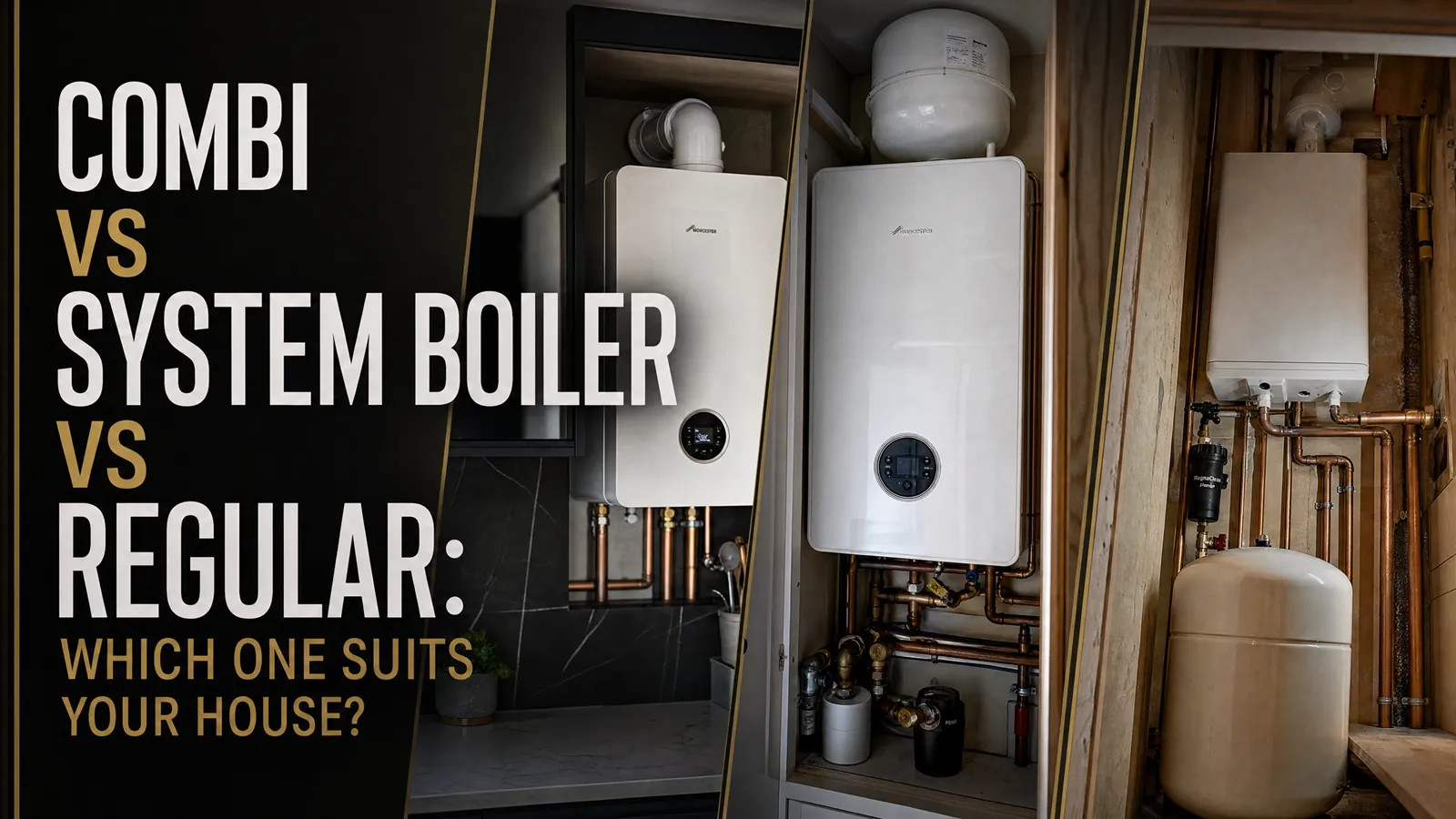
Combi vs system boiler vs regular comes down to two questions: how many people want hot water at the same time, and how much water your mains can actually deliver. One bathroom and a decent mains supply, and a combi is almost always the right answer. Two bathrooms in genuine simultaneous use, and a system boiler with a cylinder will serve you better. A regular boiler, the one with tanks in the loft, is now something you keep for a reason rather than something you choose.
That is the short version. The rest of this page is the reasoning behind it, because picking the wrong type is the most common way a perfectly good installation ends up disappointing the people who paid for it. The boiler works exactly as designed. It was just never the right boiler for that house.
What the three types actually do differently
Underneath the badges, a boiler only has to answer two questions. Where does your hot water come from when you open a tap, and where does the water in your radiators sit when nobody is heating it.
Combi
A combination boiler does both jobs from one box on the wall. No cylinder, no tanks, nothing in the loft. Open a hot tap and the boiler fires, heats the water as it flows through, and keeps doing that for as long as the tap is open. You wait a few seconds, then it runs hot until you turn it off. The heating side is sealed and pressurised, which is what the gauge on the front of the boiler is telling you about.
The catch is that a combi can only heat water as fast as your mains can push it through. That single number decides whether a combi is excellent in your house or a daily irritation.
System
A system boiler heats a cylinder, and the cylinder is what feeds your taps. The pump and the expansion vessel live inside the boiler, so there is nothing loose in the airing cupboard except the cylinder itself. Most modern ones are unvented, which means the cylinder is fed straight off the mains and delivers hot water at mains pressure to every outlet in the house.
Because the water is already hot and waiting, two showers running together do not fight each other. What you have instead is a finite amount of it, and a reheat time once it is gone.
Regular
Also sold as heat only, conventional or traditional, and they all mean the same thing. A regular boiler heats the water and nothing else. There is a cold water storage cistern in the loft feeding the cylinder, a smaller feed and expansion tank next to it serving the radiators, a cylinder in the airing cupboard, and usually a pump sat on the pipework near it.
The pressure at your taps comes from the height of that tank above them, not from the mains. It is why an upstairs shower in an old house can be weak while the kitchen tap downstairs is fine. It is also why these systems are forgiving of a poor incoming supply, which is the one genuine argument still left in their favour.
Combi vs system boiler: which one suits your house?
Ignore bedroom counts. Estate agents measure houses in bedrooms and boilers do not care. What matters is how much hot water gets drawn at the same moment, and what the mains can do about it.
One bathroom, one or two people, mains above about 12 litres a minute. Combi, comfortably. You get the airing cupboard back, the loft empties out, and you are not paying to keep a tank of water hot for a shower you might not take.
One bathroom plus a downstairs cloakroom. Still a combi. A basin tap running while the shower is on takes very little away from it.
Two bathrooms, used at different times of day. A combi will cope, if the mains supports it. Be honest about the word different. Two teenagers and one school run is not different times of day.
Two bathrooms in real simultaneous use, or a bath being run while someone showers. System boiler and an unvented cylinder. This is the case a combi cannot win, whatever output you buy, because you cannot heat water the mains will not deliver.
Mains below about 10 litres a minute. A combi is the wrong answer regardless of how many bathrooms you have. Either the supply gets improved first, or you store the water instead.
There is a middle option that gets overlooked. A storage combi holds a small internal tank, perhaps 40 to 70 litres, and uses it to cover the first burst of demand before switching to heating on the fly. It is bigger and dearer than a plain combi and it will not run two showers all evening. In a house that is marginal on flow, it can be the thing that makes a full cylinder unnecessary.
How do I find out what my mains can actually deliver?
You can measure it yourself in two minutes, and it is worth doing before anybody quotes you.
Take a measuring jug, or a bucket you know the capacity of, to the kitchen cold tap. That is the one fed straight off the rising main.
Turn it fully on and time how long it takes to fill.
Convert to litres a minute. A two litre jug filled in ten seconds is twelve litres a minute.
Under 10 litres a minute and a combi will always feel weak, because that is roughly the point below which the manufacturers stop promising anything useful. Between 12 and 15 is ordinary and works well for one bathroom. Above 20 and you can fit more or less what you like.
Two things skew the test. Flow drops when everyone else on the street is using water, so a reading taken at half past ten on a Sunday is a kinder number than the one you get at seven on a Tuesday. And pressure is not flow. A supply can hold good static pressure and still trickle, usually because the pipe feeding the house is old and narrow. Joe measures the flow rate on the survey rather than reading the pressure and assuming, because the two disagree often enough to matter.
If the number comes back low, there are answers short of giving up on a combi. A new mains connection in a larger pipe, where the existing one is lead or half inch, often transforms it. An accumulator, which is a pressurised store that buffers the supply, is the other route. Both cost money, so they belong in the conversation before you commit to a boiler type, not after.
When is a system boiler worth the cylinder it needs?
When more than one outlet wants hot water at once, often enough that you would notice it failing.
An unvented cylinder gives you mains pressure hot water everywhere, upstairs included, which is the part people notice first if they are coming off a gravity system. Two showers run properly together. Filling a bath does not stop the kitchen working. The trade-offs are real and worth knowing before you sign:
It takes up space. A cylinder for a family of four is normally 180 to 250 litres, and that is a cupboard you are not getting back.
It runs out. Not often, but it can, and then you wait. Reheating is typically half an hour or so for a partial recovery and longer from cold.
It is a regulated appliance in its own right. Unvented cylinders sit under Part G of the Building Regulations. The installer needs the separate qualification for them, the cylinder needs a safe discharge route from the temperature and pressure relief valve, and it wants checking every year. Ask to see that ticket, not only the Gas Safe card.
There is one more case for a system boiler that nobody sells you. If you already have a cylinder in good order and no appetite for the upheaval of ripping it out, replacing a system boiler like for like is a straightforward day. Converting the whole house to a combi is not.
Is there any reason left to keep a regular boiler?
A few, and they are better reasons than the trade usually admits.
If the incoming mains genuinely cannot be improved, a stored, gravity fed system is not a compromise. It is the only thing that will work. Some older properties have supplies that cannot be upgraded without digging up land that is not yours, and no boiler on the market can pump water that is not arriving.
Old pipework is the second reason. A house plumbed decades ago, in wide bore pipe with radiators to match, was designed around low pressure and slow circulation. It can be converted, but the conversion is more than a boiler swap, and doing it properly sometimes costs more than the benefit is worth.
What has genuinely gone are the reasons people used to give for keeping the tanks. The header tank as a top up for a leaky system, and the immersion heater as a backup. If a system needs constant topping up it has a fault worth finding, and on a sealed system that same slow loss shows up as a boiler steadily losing pressure, which at least tells you something is wrong instead of quietly hiding it.
What do the rules require, whichever type you choose?
Since April 2018, new gas boilers fitted in England have had to meet the Boiler Plus standard. Three parts of it matter to you as the person paying.
The boiler has to be at least 92 per cent efficient on the ErP scale, which every mainstream condensing boiler already is. It has to go in with time and temperature control, meaning a programmer and a room thermostat at minimum. And if it is a combi, it needs one additional efficiency measure on top: flue gas heat recovery, weather compensation, load compensation, or a smart control with automation and optimisation.
That last one is what quietly appears on quotes as a smart thermostat. For a combi in England it is a genuine requirement rather than an upsell, though which of the four you pick is very much a conversation worth having. Current detail sits with the Government's own guidance, and your installer has to notify the installation to Building Control whichever type goes in.
All of that depends on the person fitting it being registered. Joe's number is 633652, and it takes about thirty seconds to check us on the Gas Safe Register. Do it for every quote you get, not only for this one.
What does changing type actually involve?
Staying with what you have is always the cheaper option, and that is not a reason to stay if the system is wrong for the house. It is a reason to know what you are taking on.
Like for like, combi for combi or system for system in the same position, is a single day. Nothing structural changes and there is nothing to make good afterwards.
Converting a cylinder system to a combi is normally two days. The cylinder comes out, the loft tanks are drained, disconnected and removed, and the pipework that fed them is either reused or capped off properly. Leaving a redundant tank sitting in a loft is not a saving, it is a stagnant water problem for whoever buys the house next. Expect a bit of plastering and decorating afterwards, in the airing cupboard at least.
Taking out a back boiler is the biggest of the common jobs, because the old unit sits behind the fireplace and the chimney breast has to be opened up to reach it. Two days, sometimes three, and the making good is part of the work rather than an afterthought.
For what each of those costs, there is a full breakdown in the guide to what a new boiler costs in 2026, with the ranges by job type and what moves them.
What Joe sees in Barnsley and the Dearne Valley
The housing round here is mostly 1930s semis and terraces that went up before the war, and both come with history. Back boilers behind fireplaces are still in service in houses across Barnsley, Jump and Wombwell. Gravity systems with a cylinder and two tanks in the loft are ordinary rather than unusual. Nobody chose either of those this century, and plenty of people are still living with them.
Two mistakes come up more than any others.
The first is fitting a combi in a house that cannot feed one. It is the default recommendation everywhere, it is right most of the time, and when it is wrong the homeowner spends the next ten years with a shower that goes cold every time the washing machine fills. Measuring the mains first takes two minutes and prevents all of it.
The second is the opposite. Heating a full cylinder every day in a house where one person takes one shower is a tank of water kept hot for nothing, in a cupboard that could be storing something, on a system with more parts to go wrong than it needs.
Joe will tell you which of the three suits your house, and he will tell you when the honest answer is that the boiler you already have is fine and this is a repair rather than a replacement. What an installation includes, from the survey through to the flue gas analyser reading at the end, is set out on the boiler installation in Barnsley page.
If you want the mains measured and a real answer for your own house, that is a phone call on 07791 793415. WhatsApp works on the same number if it is easier to show him the cupboard than describe it. Joe works across Barnsley and the Dearne Valley, and out to Rotherham, Sheffield, Doncaster and Wakefield. Asking whether you should change type at all is a perfectly good reason to ring, and the answer is sometimes no.