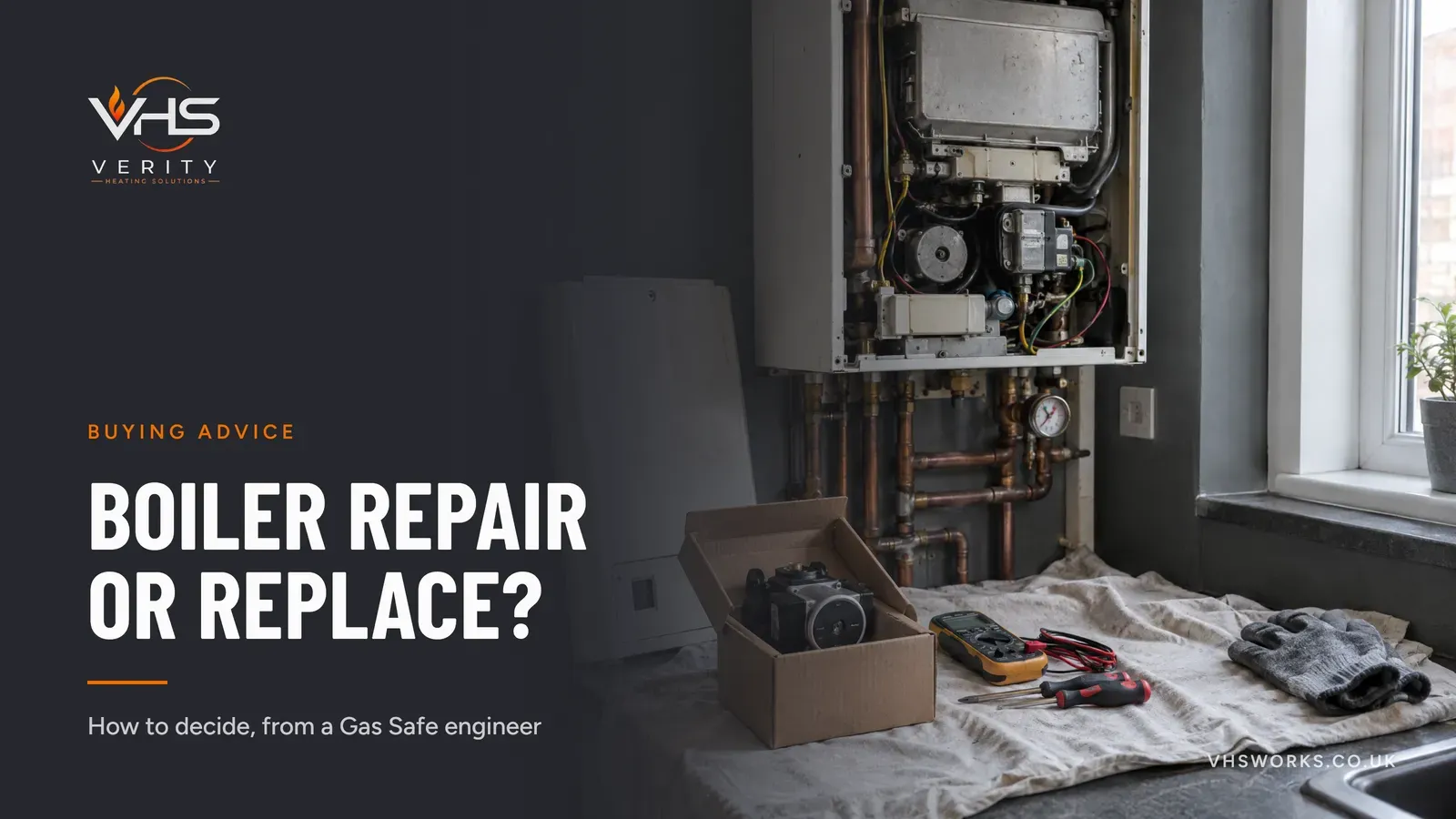
Start with two facts: how old the boiler is, and which part has failed. Those two settle most boiler repair or replace decisions before anyone talks money. A young boiler with a small fault gets fixed. An old one with an expensive fault, or with a habit of breaking down, is usually where the money is better spent on something new. The cases in between are what this page is for.
Joe Haywood is a Gas Safe registered engineer in Barnsley who does both repairs and new installs. A diverter valve pays him less than a new boiler, and he will still tell you to keep the old one when it has years left in it.
Boiler repair or replace: the short answer by age
Age is not the whole story, but it is the best place to start. Baxi's own guidance is that a boiler should last 10 to 15 years if it is serviced every year and looked after properly.
- Under 8 years. Repair, almost always. Check the warranty first: a lot of boilers fitted in the last few years are still covered, as long as the annual service has been kept up. A covered repair may cost you nothing beyond a call to the manufacturer.
- 8 to 12 years. Repair, unless the part is one of the expensive ones or the boiler has a history. This is where the honest conversation happens.
- 12 to 15 years. It depends on the part, the make, and how long you expect to live there. A cheap fix is still a cheap fix. A circuit board on a boiler this age deserves a proper think.
- Over 15 years. Lean towards replacing, especially if it is a non-condensing model or a back boiler. Fix it if the part is small and you need to get through a winter, but start planning.
Four things that decide it
1. What the part actually costs, fitted
A fault code is not a price. The same symptom, no hot water for instance, can be a jammed diverter valve or a failed circuit board, and those are very different bills. Joe finds the actual fault before anybody talks about replacing anything, because a decision made on a guess is not a decision.
2. How often it has gone wrong
One fault in ten years is a boiler doing its job. Three callouts in two winters is a pattern, and patterns on older boilers tend to continue. Each repair on its own can look sensible while the total quietly overtakes the price of something new.
3. The state of the system around it
Sometimes the boiler is not really the problem. Sludge from old steel radiators wears out pumps and blocks heat exchangers, and it will do the same to a brand new boiler if nobody deals with it. If the water is black, the fix may be cleaning the system, not changing the appliance.
4. How long you are staying
If you are selling next year, a few hundred pounds of repair on a working boiler usually beats several thousand on a new one. If you are staying ten years, the sums tilt the other way, because a new boiler brings a fresh manufacturer's warranty and you stop paying for breakdowns one at a time.
Why the 50 per cent rule is only a starting point
You will see a rule of thumb quoted online: if the repair costs more than half the price of a new boiler, replace it. It is not wrong, but it hides two things.
First, it ignores age. A few hundred pounds of repair on a five year old boiler is well under half the cost of a replacement and obviously worth doing. The same bill on an eighteen year old boiler is also under half, and is often money that buys you one more winter.
Second, it treats the repair as the last one. On a young boiler it probably is. On an old one, the next part is already wearing. It is worth thinking about the next three years of bills, not just the next one.
Repairs that are usually worth doing
These are common faults, and on a boiler with life left in it they are almost always worth fixing. For typical costs, part by part, see the price table on the boiler repair in Barnsley page. Joe gives you a fixed price once he has found the fault.
- Diverter valve. The classic fault where the heating works and the hot water does not.
- Circulating pump. No heat to the radiators, sometimes with a hum or a grinding noise from the boiler.
- Pressure problems. Often a leak somewhere in the system, or an expansion vessel that has lost its charge, and frequently cheaper than people expect.
- Ignition and sensor faults. Electrodes, thermistors and flame sensors are small parts and usually small bills.
The two that deserve a harder look are the circuit board, or PCB, and the gas valve. They are among the dearer repairs. On a young boiler, fix them. On one heading for its fifteenth birthday, that money is often better put towards a replacement.
When replacing is the better use of the money
Some boilers are worth replacing even when the current fault is small. If any of these apply, ask about replacement before paying for the repair.
- It is non-condensing. No white plastic condensate pipe running to a drain, often a permanent pilot light. These older appliances send a lot of their heat straight up the flue. Replacing one is where a new boiler really does change the gas bill.
- It is a back boiler. They still turn up behind the fireplace in the pre-war terraces and 1930s semis around Barnsley and the Dearne Valley. They can be repaired, but they are old by definition, and the replacement gets no easier for being put off.
- The heat exchanger is leaking or cracked. It is the heart of the boiler and among the dearest parts to change. On anything but a young boiler, it is usually the end.
- Parts are hard to get. When the right part has to be hunted down rather than ordered, a breakdown in January can mean days without heat.
- It has been turned off as unsafe. If an engineer finds a dangerous fault, such as a flue problem or signs of carbon monoxide, the boiler is made safe and left off. Sometimes the repair is straightforward, sometimes it is not worth doing. Ask for the reason in writing either way.
What replacing involves today
If it does come to a new boiler, a few things have changed since your old one went in. Under the government's Boiler Plus standards, which have applied in England since April 2018, a new gas boiler fitted into an existing system must reach at least 92% ErP efficiency. When a gas boiler is fitted, the system must also have a working timer and room thermostat, and a new combi needs one extra energy saving measure alongside it: weather compensation, load compensation, smart controls with automation and optimisation, or flue gas heat recovery. The detail is in Approved Document L on GOV.UK.
None of that is something to worry about. It is part of what a proper installation includes, and a quote should show which measure is being fitted. For realistic fitted prices by type of job, from a straight combi swap to a back boiler conversion, see new boiler prices for this year, job by job.
Whichever way you go, keep the yearly service up afterwards. It is usually a condition of a manufacturer's warranty, and it is the cheapest way to push the next version of this question further into the future.
How Joe handles a repair or replace call
He comes out and finds the fault. Then you get the plain version: what is wrong, what the repair costs, how old the boiler is and whether it is worth doing. If the repair makes sense, he gives you a fixed price before he starts, and it does not move afterwards.
If replacement makes more sense, he says why and gives you a fixed price for that too. If the honest answer is that you do not need it, he says so. Either way, Joe checks the combustion readings with his flue gas analyser and shows you everything working before he goes. Payment is on completion, not before.
One engineer from start to finish, no call centre and no subcontractor. Joe's Gas Safe registration number is 633652, so check us on the Gas Safe Register. Louise put it this way in a Google review: "Excellent communication. Always provides detailed reasons for chosen repair. Good value."
Joe covers Barnsley, Doncaster, Rotherham, Sheffield and Wakefield (see the towns Joe covers). If you already know it is time, see new boiler installation in Barnsley. Otherwise ring Joe on 07791 793415, or WhatsApp a photo of the boiler and the code on its display to that number, and ask for a straight answer.