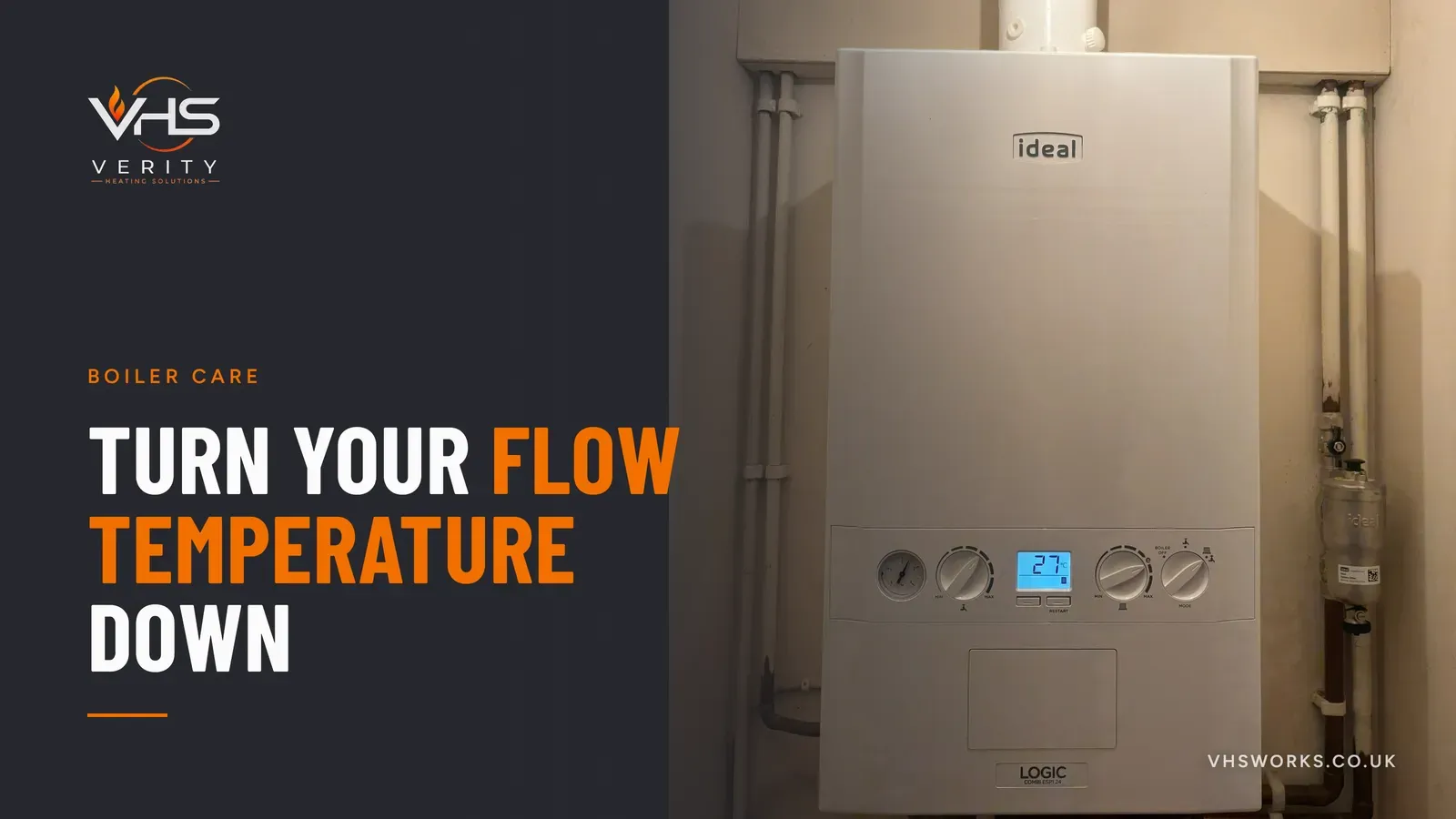
If someone at work has told you to "turn the boiler down" and you're stood in front of it not sure which dial they meant, it's the heating one, and they've given you good advice. Turning the boiler flow temperature down to around 60°C is one of the very few money-saving tips that costs nothing and actually does something. The flow temperature is just how hot the water is when it leaves the boiler and sets off round your radiators, and on most combis it's one of the dials on the front. If yours is turned well up, it's worth a go this week.
It isn't right for every house, mind, and on one kind of system you shouldn't touch it without a bit of thought, so it's worth knowing why it works before you start turning things.
What condensing has to do with it
Nearly every gas boiler fitted in England since 2005 is a condensing boiler, because building regulations have required them ever since. The clever bit is what happens to the fumes. Before they leave through the flue, they're run past the cooler water returning from your radiators, and if that water is cool enough the steam in them condenses, the same way your breath fogs a cold window. Turning steam back into water gives off heat, and the boiler grabs that heat for your radiators rather than blowing it outside. The water it makes is what trickles away down the plastic condensate pipe.
It only works properly, though, when the water coming back is cool enough. Nesta, the charity behind the Money Saving Boiler Challenge, puts that point at around 54°C. Now picture a combi turned up to 80. The water leaves hot, gives some of that heat to your rooms, and comes back far too warm for much condensing to happen at all. The house still gets warm, so nothing seems wrong, but you're running a less efficient boiler than the one you paid for. Bring the flow down to 60 and the water comes back cool enough for it to work the way it was designed to.
How much it could knock off your gas bill
Nesta tested this properly, partly in the Energy House at the University of Salford, which is a real two-up two-down built inside a climate-controlled chamber. Their evidence report gives a headline figure of about 9 per cent off your total gas use for a combi going from 80°C to 60°C, and other estimates in the same report sit a little lower, nearer 6 to 8. All of them assume the boiler started out turned well up, so if yours is already sitting at 65 you'll save less.
There's no honest pound figure to give you, though. It hangs on how much gas you burn and what you're paying per unit, and anyone promising you an exact saving without looking at your bills is guessing. What makes it worth trying is that you don't buy anything and nobody has to come out.
The catch: warm-up time and the coldest room
Cooler radiators put out less heat each minute, so the house takes longer to come up to temperature. In Nesta's test house, going from 80 down to 60 added about 17 minutes to the warm-up. That's easy to live with if you change one habit: set the heating to come on a bit earlier, and leave the thermostat where it is. Cranking the thermostat up to get warm faster doesn't help, because the thermostat only decides when the boiler stops, not how hot the radiators run.
The bigger question is whether your radiators can keep up on a properly cold day. Radiators are sized for the room they're in, and in a lot of the older houses round here, the terraces from before the war and the 1930s semis that fill whole streets of Barnsley and the Dearne Valley, a radiator that was only just big enough with the boiler turned up can struggle once it's turned down. Nesta say much the same: a poorly insulated house, or somebody who likes their front room properly toasty, may find the target temperature harder to reach. They also don't recommend it if you only ever heat one room.
It's still well worth a go, though, as long as you keep an eye on your coldest room. If that room gets where you want it on a cold evening, you're sorted, and if it doesn't, nudge the dial back up five degrees rather than going all the way back to where you started.
How to turn the flow temperature down on a combi
On most combis it takes about a minute, and there's no casing to remove or tool to find.
- Find the heating control. Most combis have two, one marked with a radiator symbol for the heating and one with a tap symbol for the hot water. You want the radiator one.
- See what it's set to now. Plenty of boilers show the temperature on the display while you turn the dial. If yours only has marks from min to max, the manual for your model will tell you what each one means, and most makers put their manuals online for free.
- Turn it down to 60°C, or as near to it as your boiler allows.
- Live with it for a week, ideally through at least one cold snap, before you decide whether it's working for your house.
Some newer boilers tuck the setting away in a menu instead of putting it on a dial, and some heating controls manage the flow temperature for you, turning it down as the house gets close to the temperature you've asked for. If you've got one of those, it's worth reading up on how it's set before you override it. And if you genuinely can't tell which button does what, don't start pressing everything until something happens. Ring Joe with the make and model and ask.
Got a hot water cylinder? Slow down a bit
Everything so far is about combis, which heat your tap water as you use it. If you've got a system or regular boiler with a hot water cylinder in the airing cupboard (if you're not sure which you've got, our piece on combi, system and regular boilers will help), the same boiler usually heats that cylinder as well. A tank of stored hot water needs to get hot enough to keep legionella bacteria down, and HSE's guidance is that stored hot water should be kept at 60°C at least.
That's why Nesta's advice for cylinder homes is more cautious. They suggest those boilers can usually come down to 65°C rather than 60, which means a smaller saving, and they point out that Which? recommends getting a heating engineer to make the change, which is sensible advice. On some systems the cylinder has its own thermostat and the boiler setting just needs to stay comfortably above it; turn the boiler down too far on one of those and the cylinder never quite gets up to temperature. An engineer can tell which setup you've got pretty quickly, so it's worth asking rather than guessing.
What about the hot water dial on a combi?
People often turn both dials down while they're stood there. On a combi, the hot water dial sets how hot the water comes out of the tap. Taking it down a little can save some gas, because there's not much sense heating water scalding hot only to cool it straight back down with the cold tap at the basin. Just don't take it so low that the shower feels lukewarm on a winter morning, or you'll stand under it longer and lose whatever you saved.
When the dial isn't the problem
Sometimes the flow temperature gets turned down, the house feels cold, and the dial gets the blame for something that was already there. If a radiator was cold along the bottom before you touched anything, that's usually sludge, and a cooler flow will make it more obvious rather than cause it. Our article on radiators that are cold at the bottom explains what's going on, and if it looks like the whole system is affected, there's more on Joe's radiators and powerflushing page.
The same goes if the pressure keeps dropping, or you've got hot taps but the radiators won't come on at all. No amount of fiddling with the dial will sort either of those, because something has actually gone wrong, so have a look at the guides on a boiler losing pressure and hot water but no heating.
Getting it set right at your next service
The dial is yours to turn and you don't need anybody's say-so. A boiler service is still a good time to ask about it, though. The casing's off, Joe tests the boiler on his flue gas analyser and shows you it's working before he goes, and while he's there he can tell you whether your settings suit the house. What's included is on his boiler servicing page, and if you've ever wondered whether it's worth doing every year, there's an article on how often to get it serviced.
"Punctual, professional, tidy." Dawn, on Google
Joe's Gas Safe registration, 633652, is public (feel free to check us on the Gas Safe Register), and there's no call centre or subcontractor in between: you ring Joe, and Joe comes out, from his base in Barnsley out to Rotherham, Sheffield, Wakefield and Doncaster. Not sure whether to touch the dial, or tried it and the house won't warm up? Ring 07791 793415, or WhatsApp Joe on that number, and you'll get a straight answer.