A proper boiler service checklist has about ten items on it, and you can watch most of them happen. The casing comes off. A probe is pushed into the flue and numbers come up on a screen. The gas is measured, the condensate trap is emptied, the safety devices are tested, and you are handed a written record with the readings on it. Allow 45 minutes to an hour. If nobody opened the boiler, it was not a service.
This page is written from your side of the kitchen. It covers what you should see at each step, how to read the record you are given afterwards, and how to tell a real service from a quick look and an invoice.
What is on a proper boiler service checklist?
Here is the list, with what each step looks like to somebody standing nearby with a cup of tea.
A look before touching anything. The engineer checks around the boiler for stains, drips and scorch marks, and asks whether it has been behaving. Mention anything odd now, even if it seems minor.
The flue is followed. Inside to where it leaves the building, then outside to check the terminal is clear and sound. If your flue runs through a ceiling void, as in many flats, there should be hatches so it can be seen along its length.
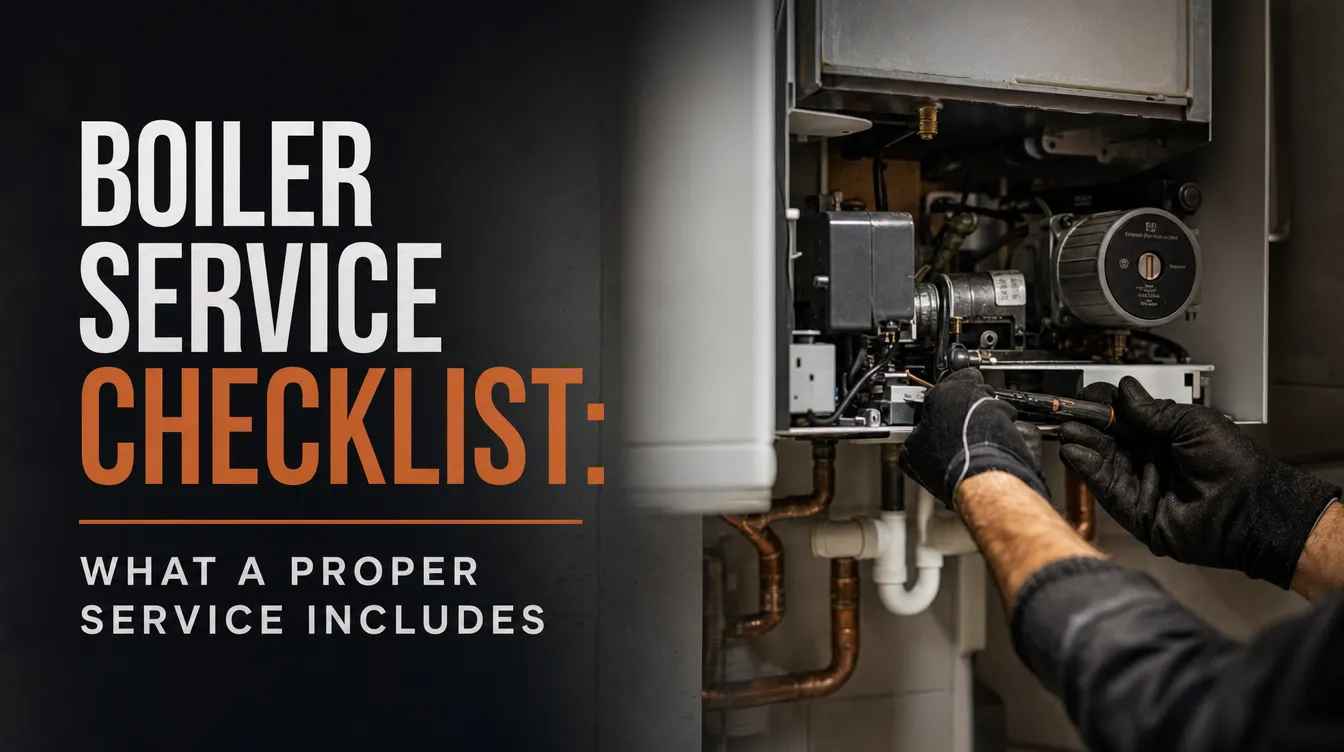
The casing comes off. You will see the front cover on a dust sheet and the inside of the boiler exposed. This is the step that separates a service from a glance.
Inside is inspected. Seals, electrodes, the burner, signs of leaks or overheating. Parts are cleaned if they need it.
The condensate trap is emptied. A small plastic pot under the boiler is removed, rinsed and refitted. Expect a bucket.
Gas pressure and gas rate are measured. A gauge is connected at the boiler, and the engineer may time the gas meter. You might be asked not to use the hob for a couple of minutes.
Flue gases are analysed. A probe on a hose goes into a test point on the flue and a handheld analyser shows the readings. This is the heart of the service.
Safety devices are tested. The boiler is made to prove it shuts down when it should.
The system side is checked. Pressure gauge, expansion vessel, and the magnetic filter, if you have one, emptied.
The record is written up. Readings go on a service sheet and in the Benchmark section at the back of the boiler manual, and you are told what was found.
The detail of what Joe does at each stage, and why, is on the boiler servicing page. The rest of this guide is about the parts you can check for yourself.
What should you do before the engineer arrives?
Five minutes of preparation makes the hour go further.
Clear the way to the boiler. Empty the cupboard it lives in. If it is in the loft, make sure the ladder and the light work.
Find the paperwork. The boiler manual and last year's service record, if you have them. The Benchmark pages are at the back of the manual.
Know where the gas meter is, and make sure it can be reached.
Write down anything it has been doing. Noises, pressure dropping, a fault code that came and went. A note on your phone is plenty.
Leave the heating off for an hour beforehand if you can, so the boiler is cool enough to work on.
Be at home for it. You will have no heating or hot water while the boiler is open, and the readings mean more if you are shown them as they are taken.
How do you read the numbers on a boiler service record?
This is the part most people never get explained, and it is not complicated. The analyser samples the gases leaving the boiler, and three figures matter.
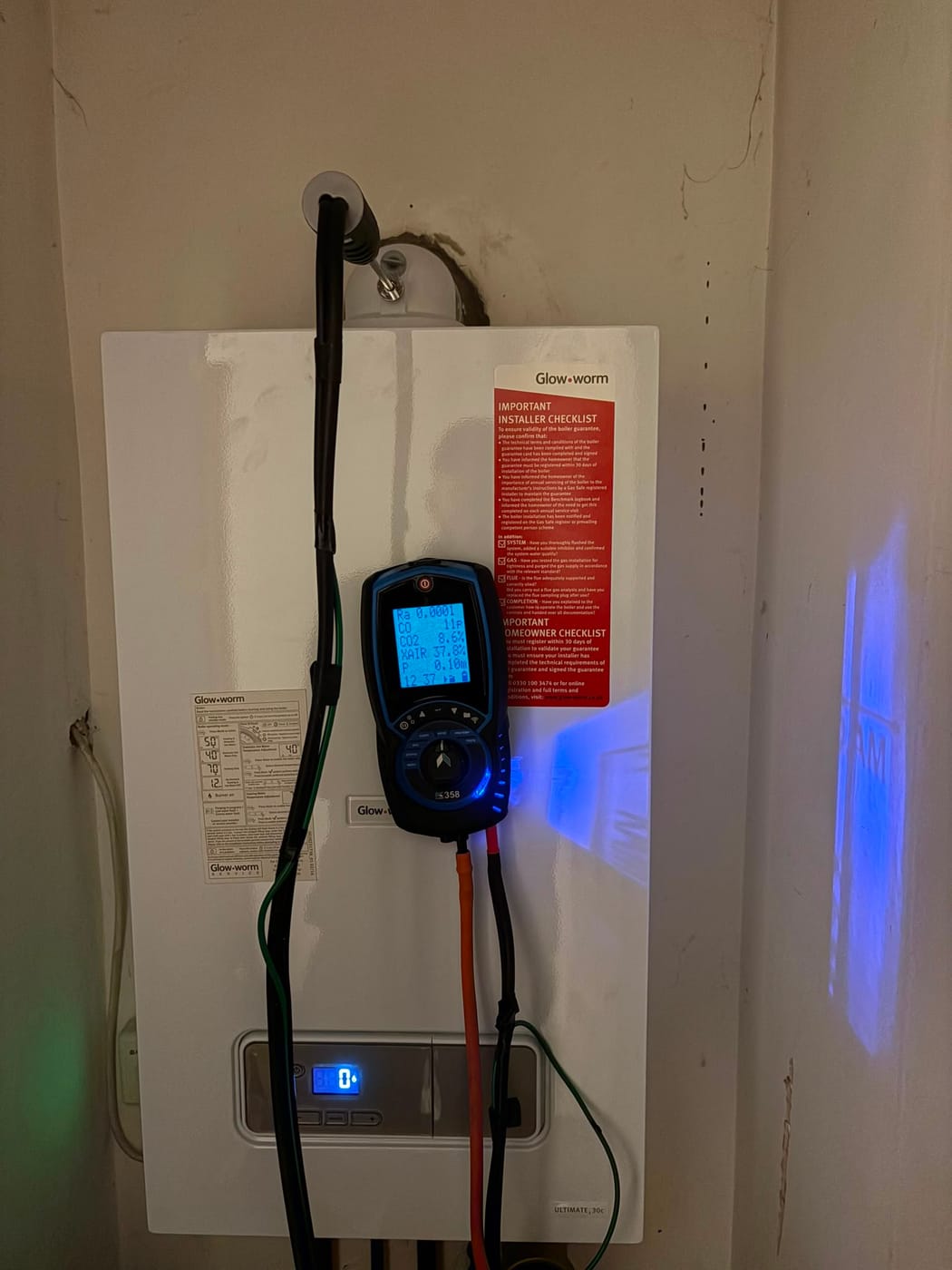
The photo is one of Joe's own readings. Taking it line by line:
CO, carbon monoxide. The dangerous gas, measured in parts per million. A boiler burning cleanly produces very little. The one in the photo reads 11.
CO2, carbon dioxide. Shown as a percentage. It tells the engineer whether the mix of gas and air is right. Each manufacturer gives a target range for each model, usually somewhere around 8 to 10 per cent on natural gas. The photo shows 8.6.
The ratio. CO divided by CO2, and the single most useful number on the sheet. Industry guidance sets the ceiling for most modern boilers at 0.004 unless the manufacturer says otherwise. The lower it is, the cleaner the burn. The photo shows 0.0001, which is about as good as it gets.
Your record should also show the gas pressure. Natural gas arrives at the meter at around 21 millibar, and the reading at the boiler will be a little lower. The manual gives the minimum the boiler needs.
You do not have to remember any of that. What matters is that the numbers exist, that they are written down, and that the engineer can tell you in a sentence whether they are good.
Does the checklist change with the type of boiler?
The ten steps stay the same. What gets added depends on what you have.
A combi. The hot water side is tested as well: a tap is run to check the boiler fires for it and the water comes through at a sensible temperature.
A boiler with a cylinder. The engineer checks that the boiler responds when the cylinder calls for heat, which also proves the valve and thermostat that control it.
An older open flued boiler or a back boiler. These take their air from the room, so the ventilation is checked and a smoke test is done at the appliance to prove the fumes are being drawn up the flue and not spilling back.
An older boiler that is not a condensing type. There is no condensate trap to empty, so that step drops out.
What happens if the boiler fails a check?
The gas industry has a set procedure for this, and every registered engineer follows the same one. A fault that could become dangerous is classed as At Risk. The engineer will ask your permission to turn the appliance off, and attaches a warning label. A fault that is dangerous now is classed as Immediately Dangerous, and the engineer will ask to disconnect it. Either way you get a written notice explaining what was found.
It is rare, and it is not a sales tactic. If it happens, ask to be shown the problem and what would put it right.
What does a boiler service not include?
A service looks, cleans and tests. It is not a repair, and the price does not cover parts. If something is found, you should be told what it is and what it would cost, and then it is your decision.
It also stops at the boiler. These are separate jobs, and worth knowing about before you assume they were done:
The radiators and pipework. Cold spots and sludge are a system problem. They are dealt with under radiators and powerflushing.
Other gas appliances. A hob, a cooker or a gas fire is not looked at unless you ask.
A landlord's gas safety record. That is a legal check covering all the gas appliances in a rented home, with its own form. It is explained under landlord gas safety certificates.
A pressurised hot water cylinder. It has its own safety valves and its own yearly check.
How can you tell if the service was done properly?
You do not need to understand boilers. You need to notice four things.
Time. A real service on a modern boiler takes most of an hour. If the van was outside for fifteen minutes, steps were missed.
The casing. Was the front off? If the engineer only looked at the outside and pressed a few buttons, that was an inspection.
The analyser. Did a probe go into the flue, and were you shown or given the readings? No readings means nobody knows how the boiler is burning.
The record. You should be left with something in writing that carries the date, the engineer's Gas Safe number and the figures. A tick on a carbon pad that says "serviced" is not that.
If any of those is missing, ask about it there and then. A good engineer will not mind in the slightest. And if you are still deciding whether a yearly visit is worth paying for at all, the case for and against is in this honest look at annual servicing.
Who should you book?
Anyone Gas Safe registered who will do everything on the list above and show you the numbers. Check the registration before they arrive. It takes less than a minute on the Gas Safe Register website, and the card they carry lists what they are qualified to work on.
Joe's number is 633652. He services boilers across Barnsley and in Sheffield, Rotherham, Doncaster and Wakefield, takes the casing off every time, and photographs the analyser screen so you have the reading as well as the paperwork. To book, call 07791 793415, or WhatsApp the same number with the make of your boiler and roughly when it was last looked at.