Ideal boiler fault codes come in three families. An F code is a fault, an L code is a lockout, where the boiler has shut itself down for safety, and a C0 or C2 code is a fault with the boiler's BCC chip. Two you can usually clear yourself: F1 (low pressure) and L5 (too many resets). A third, F7 (low mains voltage), is a job for an electrician, not a gas engineer. Most of the rest want one reset, and if the code returns, a Gas Safe engineer.
That is the short version. Below are the codes on Ideal's own fault code page, what each one means in plain words, what you can safely try, and where trying stops. Joe Haywood, Gas Safe registered and based in Jump near Barnsley, fits and repairs Ideal boilers among other makes.
Reading the display before you touch anything
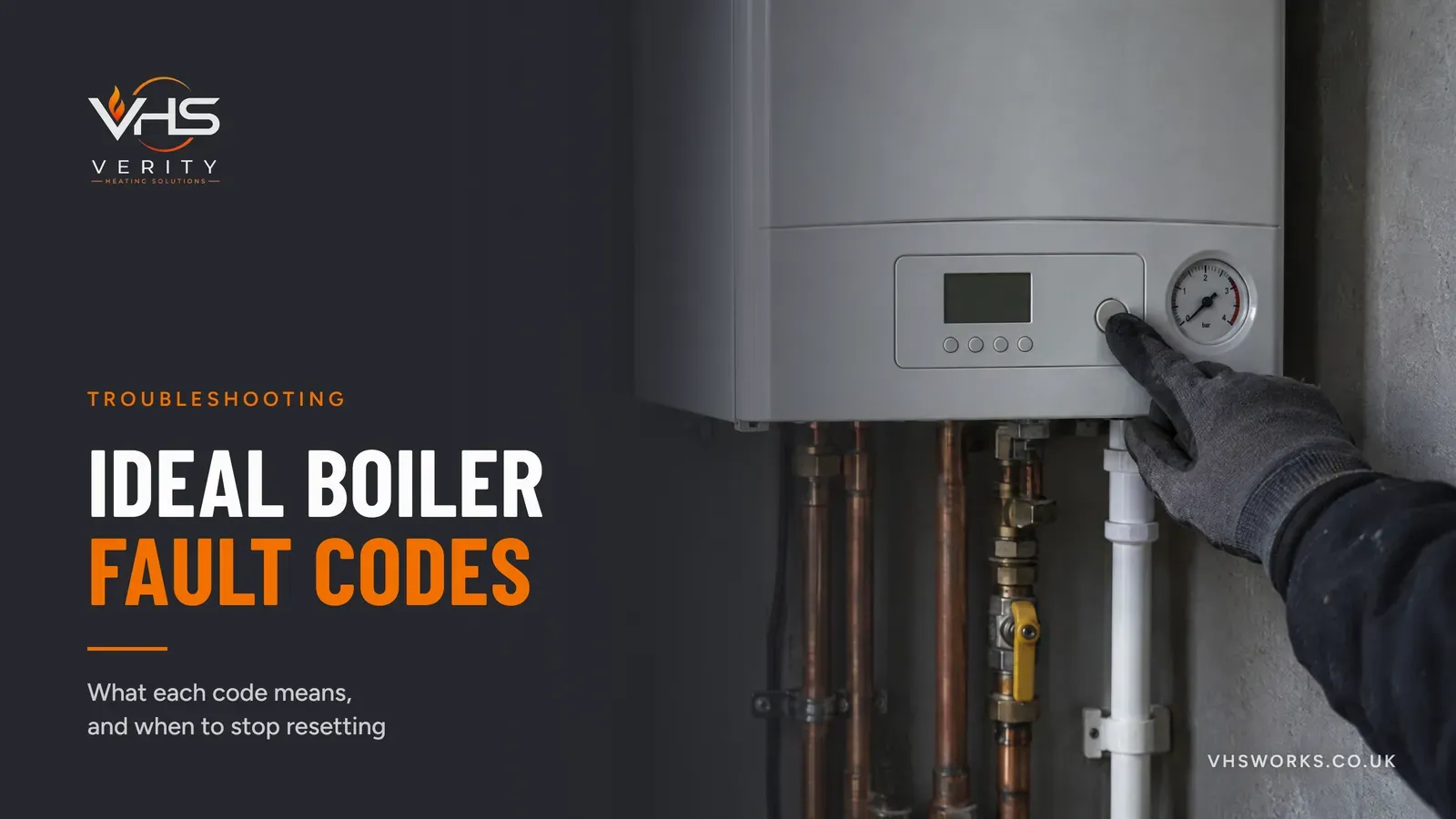
On most Ideal combis the code flashes as a letter and then a number, so "L" followed by "2" is an L2. Write it down exactly before you do anything else. Resetting clears the screen, and if the boiler then works for a day and stops again, the code is the only clue anyone has to what happened.
A few other things are worth noting at the same time, because they narrow a fault down quickly when you ring an engineer:
- What the pressure gauge reads, cold.
- Whether the hot taps, the radiators, or both have stopped.
- Whether the boiler made a noise as it tried to light: a click, a whoosh, a gurgle.
- Whether your hob or any other gas appliance is working.
- How many times it has already been reset today.
To reset most current Ideal combis you press the restart button. On the older Logic Combi with a mode knob, Ideal's user guide says to turn the knob to the reset position and straight back to the setting you want, and the boiler runs its lighting sequence again.
Ideal boiler fault codes to check before you ring anyone
F1: low water pressure
The boiler has seen the pressure in the heating system drop too low to run safely. Ideal's target is 1 to 1.5 bar. In practice that means opening the filling loop until the gauge reaches that range, closing it again, and pressing restart.
One top-up after bleeding radiators is normal. If you are topping up every week, water is leaving the system somewhere: a weeping valve, the pressure relief pipe outside, or a part inside the boiler. The boiler losing pressure article goes through where to look before you call anyone.
L5: reset too many times
Ideal's page puts it plainly: the boiler has been reset too many times in 15 minutes. It is protecting itself from someone pressing the button over and over on a fault that is not clearing. Ideal says to turn the power off and on again, which means the fused spur, a switched plate on the wall near the boiler with a fuse in it. Then stop. If the original code comes back, that code is the thing to report.
Some displays show the same reset limit as LC rather than L5. The fix is the same: power off at the spur, back on.
F7: low mains voltage
The electricity reaching the boiler is lower than it needs. This is not a boiler repair at all, and Ideal's own advice is to get a local electrician to look at the electrics in the house.
What does L2 mean on an Ideal boiler?
It means the boiler tried to light, could not hold a flame, and locked out. F2 is the same fault shown under a different letter on some models, and Ideal gives the same steps for both.
Ideal's checks:
- Is there gas in the house? Light a ring on the cooker. Pay-as-you-go meter? Make sure there is credit on it. If nothing gas works, the supply is a more likely problem than the boiler. Check the meter is on, and if it is, ring a gas engineer.
- Is the gas valve under the boiler open? It is usually a yellow lever. Open means the handle runs in line with the pipe.
- Reset once.
- Listen. If it gurgles as it tries to light, the condensate pipe is likely blocked or frozen. That is the next section.
If the gas is on and there is no gurgle, an L2 that keeps coming back is inside the boiler: the ignition, the flame sensing, the gas valve or the fan pressure side of things. Those are Gas Safe jobs, and Joe will find which one before quoting for any of it. Every repair gets a flue gas analyser reading before Joe packs up, because a boiler that lights is not the same as a boiler that burns cleanly.
The frozen condensate pipe, the L2 that isn't a breakdown
Condensing boilers produce water from their exhaust gases, and it drains away through a plastic pipe, often running outside to a drain. In a hard frost the outside section can freeze. The water backs up into the boiler, it gurgles, and it locks out on L2. Ideal's older Logic user guide describes exactly that sequence.
The same guide says what to do, if you feel up to it:
- Follow the white plastic pipe from the boiler to where it ends and find the frozen part. It is usually the most exposed bit outside, the open end, a bend, or a dip where water sits.
- Thaw it with a hot water bottle, a microwavable heat pack or a warm damp cloth, or pour warm water over it from a watering can. Not boiling water.
- Watch where that water goes, because it can freeze on the path and leave you with a different problem.
- Do not try to thaw pipework above ground level. No ladders.
- Once it is clear, reset the boiler. If it still will not light, call a Gas Safe engineer.
If the same pipe freezes every winter, ask an engineer whether it can be rerouted or insulated.
Codes where a reset is worth one try
For each of these, Ideal says to reset the boiler, and if that does not clear it, to contact Ideal (or your engineer, if the boiler is out of warranty) quoting the code, because a visit will be needed. One reset. Not five.
L1: flow temperature overheat or no water flow
The water leaving the boiler is too hot, usually because it is not moving round the system fast enough. Ideal's checks are to make sure the radiator valves are open and the gauge shows 1 to 1.5 bar, then reset. Closed valves after decorating, air in the system, low pressure and a sticking pump can all cause it. If the radiators are cold at the bottom and the water is dark when you bleed them, sludge is a likely part of the story, and a powerflush in Barnsley may be what actually fixes it.
L3: no water flow
Similar to L1, but the boiler is reporting that water is not moving at all. Ideal's steps: check the pressure and the yellow gas valve, turn the boiler off, bleed the radiators, check the pressure is still 1 to 1.5 bar, turn it back on and reset.
L6: false flame lockout
The boiler has detected a flame when it should not have one. Reset once. If it returns, Ideal says an engineer visit is needed.
F3: fan fault
The fan pushes combustion gases out through the flue, and the boiler will not run without it working properly. A reset sometimes clears a one-off. A fan fault that repeats is a part, or the wiring to it.
F4, F5 and F0: temperature sensor faults
Thermistors are small sensors that tell the boiler how hot the water is. F4 is the flow thermistor, F5 the return, and F0 the no-water-flow thermistor. When one fails or its connection works loose, the boiler cannot trust its own readings and stops.
L4: flow thermistor, as a lockout
Some models show the flow thermistor fault as L4. Ideal's advice is the same as for F4.
F6: outside sensor fault
Only relevant if your boiler has an outdoor temperature sensor fitted, which lets it adjust to the weather. Reset it. If the code stays, it needs an engineer. Say whether the radiators are still warm when you ring.
C0 and C2: the BCC chip
C2 is a fault with the BCC chip and C0 a fault activating it. Ideal says to reset, then contact them quoting the code, because an engineer visit is needed.
What do FD and FU mean on an Ideal boiler?
FD is no water flow. FU means the return water is more than 50 degrees cooler than the water going out. Ideal says that may mean a blockage. For both, Ideal's steps are to turn the boiler off, bleed the radiators, check the pressure is back at 1 to 1.5 bar and turn it on again. With FD, if the heating pump is not running, Ideal says to contact your installer. If FU persists, Ideal says an engineer is needed for the possible blockage.
When should you stop resetting and call an engineer?
Ideal's older Logic user guide says that if a fault is known or suspected, the boiler should not be used until a Gas Safe engineer has corrected it. In practice, call when:
- the same code comes back after one reset;
- you are topping up the pressure more than once in a while;
- the boiler is under warranty, because Ideal's advice is to contact them first;
- anything involves taking a panel off. No part of fixing a fault code involves you removing the boiler casing.
If you smell gas, do not reset anything and do not use light switches or flames. Turn off the gas at the meter if it is safe to, open doors and windows, and ring the National Gas Emergency Service on 0800 111 999.
Ring Joe with the code and the answers to that list near the top of this page, and you will get an honest answer on whether it needs a visit tonight or can safely wait. If it can wait until morning, he will tell you, and you will not pay the emergency rate. If it cannot wait, his emergency boiler repair line is answered 24 hours a day.
What a fault code repair costs
The code tells you which part of the boiler stopped, not what the bill is. An F4 might be a thermistor connection that has worked loose. An L2 might be a frozen pipe, or it might be a gas valve. Joe tracks down the real fault first. You get one fixed figure before a part goes in, that figure is the bill, and payment is on completion. Typical repair costs, and what pushes them up, are on the boiler repairs in Barnsley page.
The patch runs from Barnsley out to Sheffield, Rotherham, Doncaster and Wakefield, with one engineer from the first call to the final test. Registration 633652: check us on the Gas Safe Register.
Code on the screen right now? Ring 07791 793415. On WhatsApp, send a picture of the display and the gauge to that number and ask whether it needs a visit.